
What Are the Best Replacement Options for Missing Teeth?
27 July 2026 | Blog
A missing tooth can affect more than the appearance of your smile. Depending on its location, it may make chewing less comfortable, change the way you speak or allow nearby teeth to gradually move. The best options for missing teeth depend on how many teeth are missing, the health of your gums and jawbone, your budget, and what matters most to you day to day.
There is no single treatment that suits everyone. Some people need a simple, removable replacement for one tooth, while others are considering a fixed option for several missing teeth. A dental assessment can clarify the cause of tooth loss, check the surrounding teeth and gums, and help you compare the practical trade-offs.
Why replacing a missing tooth can matter
Not every missing tooth needs to be replaced immediately. For example, a back tooth may have less visible impact than a front tooth, and some people adapt well. However, gaps can sometimes affect the bite over time. Nearby teeth may tilt into the space, the opposing tooth may move down or up further than intended, and chewing forces can become uneven.
Tooth loss can also be linked with gum disease, decay, injury or an older filling or crown failing. Identifying and managing the underlying cause is an important part of planning a replacement. A new tooth restoration will need ongoing care too, whether it is removable or fixed.
The main options for replacing missing teeth
Dentures
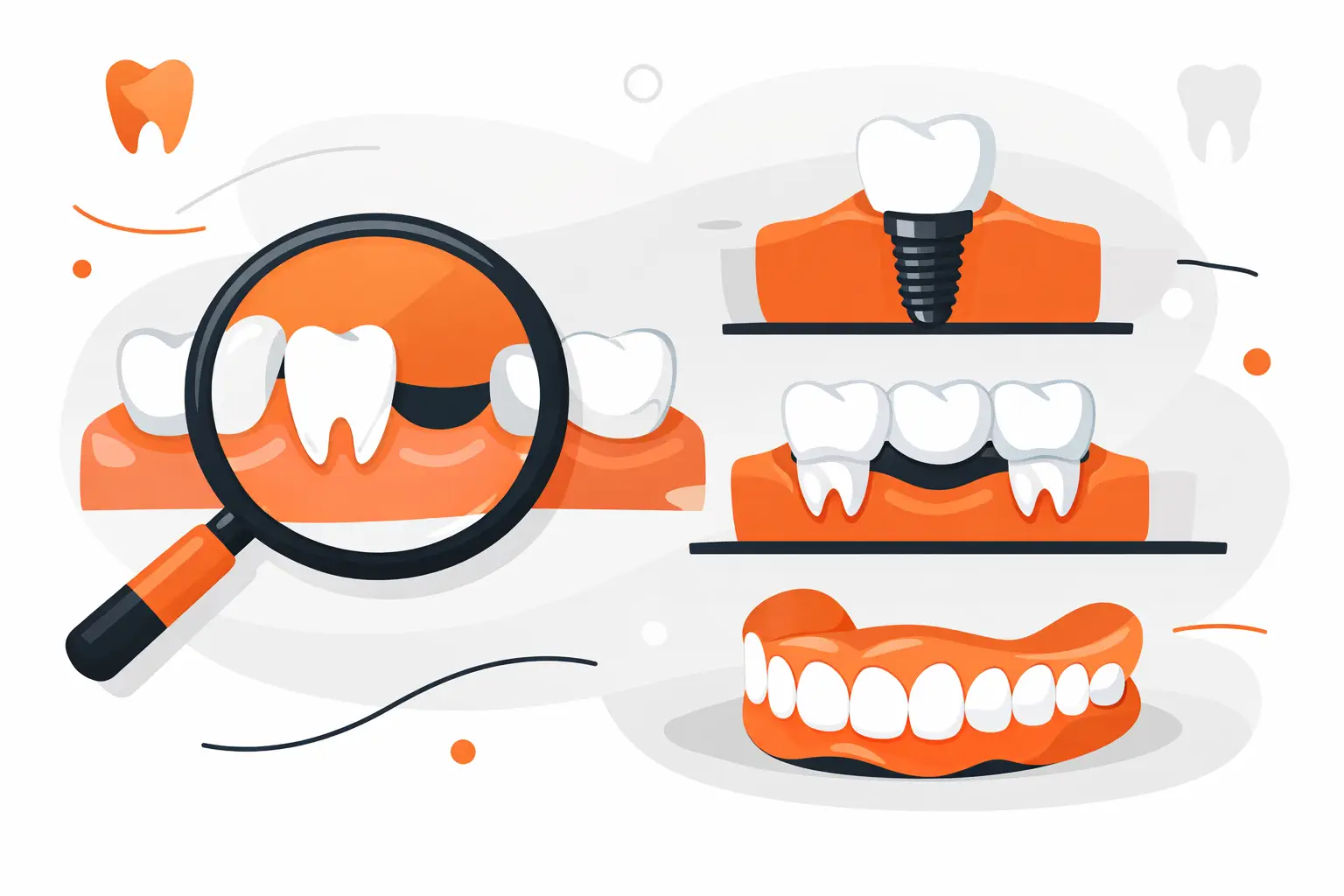
Dentures are removable appliances that replace one or more missing teeth. A partial denture sits around remaining natural teeth, while a full denture replaces all teeth in the upper or lower jaw. They are commonly made from acrylic, sometimes with a metal framework, and can be designed to match surrounding teeth as closely as practical.
Dentures may be suitable when several teeth are missing, when a lower-cost starting option is preferred, or when surgery is not appropriate. They can also be used as a temporary solution while gums heal after an extraction or while another treatment is being planned.
The trade-off is that dentures are removable and may take time to get used to. They can move slightly during eating or speaking, particularly as the shape of the gums changes. Regular reviews and adjustments may be needed. Dentures should be removed and cleaned daily, and should not generally be worn overnight unless a dentist has advised otherwise.
Dental bridges
A dental bridge replaces a missing tooth by connecting an artificial tooth to one or more neighbouring teeth. A traditional bridge is fixed in place and usually involves preparing the teeth on either side of the gap for crowns. In some situations, an adhesive bridge may be considered, particularly for a front tooth, using a wing bonded to the back of an adjacent tooth.
Bridges can feel more stable than removable dentures and do not need to be taken out for cleaning. They may be an appropriate option where the supporting teeth already need crowns or have large restorations.
A key consideration is the condition of the supporting teeth. Preparing healthy teeth for a traditional bridge is not always desirable, and a bridge does not prevent bone changes in the gap beneath it. Cleaning under the artificial tooth requires care, often with specialised floss or small interdental brushes. The longevity of a bridge varies with oral hygiene, bite forces, the health of the supporting teeth and other individual factors.
Dental implants
A dental implant is a small titanium fixture placed in the jawbone to support a crown, bridge or denture. Once the implant and bone have integrated sufficiently, a custom restoration is attached above the gumline. Implants can replace a single tooth, several teeth or, in selected cases, support a full arch of teeth.
For people who are suitable, an implant-supported tooth is fixed in place and does not rely on neighbouring teeth for support. It may also help reduce bone loss in the area of the missing tooth, although changes to bone and gums can still occur over time.
Implant treatment involves surgery and is usually completed over several appointments, often across months. Not everyone is immediately suitable. Adequate bone volume, healthy gums and general health all matter. Smoking, active gum disease, uncontrolled medical conditions and teeth grinding can affect planning and risk. Some people may need gum treatment, bone grafting or a period of healing before an implant can be considered.
Implants require careful daily cleaning and regular dental reviews. While they are not susceptible to decay, the surrounding gums and bone can develop inflammation or infection if plaque is not controlled.
Implant-supported bridges and dentures
When multiple teeth are missing, implants can support a bridge or help secure a denture. This can reduce movement compared with a conventional denture and may improve confidence while eating or speaking for some people.
Full-arch implant treatment, sometimes referred to as All-On-X, uses a planned number of implants to support a fixed full-arch bridge. It is a more involved treatment and requires detailed assessment, including consideration of bone, gum health, bite, medical history and long-term maintenance. It may not be suitable for every person with extensive tooth loss.
Comparing the best options for missing teeth
| Option | May suit | Main considerations |
|---|---|---|
| Partial denture | One or several missing teeth | Removable, requires adjustment and daily cleaning |
| Full denture | All teeth missing in one jaw | Removable, fit can change as gums and bone change |
| Dental bridge | A gap with suitable neighbouring teeth | Fixed, but may require preparation of supporting teeth |
| Single implant and crown | One missing tooth with suitable bone and gum health | Surgical treatment, longer planning and healing period |
| Implant-supported bridge or denture | Several or all teeth missing | More complex treatment and ongoing maintenance requirements |
Cost is understandably part of the decision, but it is useful to compare more than the initial fee. Ask about diagnostic appointments, extractions, temporary teeth, laboratory work, reviews, possible future repairs and the care required over time. Private health insurance rebates and payment arrangements may also differ by treatment and individual policy.
How dentists decide what may be suitable
A discussion about missing teeth should start with the whole mouth, not just the gap. Your dentist may examine your gums, remaining teeth, bite and jaw joints, and take X-rays or scans where clinically appropriate. They will also ask about your health history, medications, smoking, grinding or clenching, and your expectations around appearance, comfort and maintenance.
For example, a bridge may be a sensible option when neighbouring teeth already require crowns. An implant may be considered when it is preferable to leave adjacent teeth untouched and there is enough healthy bone. A denture may be the most practical approach when multiple teeth are missing or when surgery is not wanted. The right choice is often a balance rather than a perfect answer.
If a tooth has only recently been removed, timing matters. In some cases, treatment can be planned soon after extraction; in others, a healing period is recommended. Your dentist can explain why a particular timeframe is being suggested for your circumstances.
Looking after your replacement tooth or teeth
Every replacement option needs maintenance. Brush twice daily with fluoride toothpaste and clean between teeth each day. For bridges and implants, your dentist may recommend interdental brushes, floss threaders or other cleaning aids to reach areas beneath the restoration and around the gumline.
Dentures should be brushed with a denture brush and appropriate cleanser, then rinsed thoroughly. Avoid using hot water, which can alter their shape. Regular dental check-ups remain valuable even with full dentures, as the gums, soft tissues, bite and appliance fit should be assessed.
Contact a dentist if a denture cracks or becomes loose, a bridge feels different when biting, an implant restoration moves, or you notice bleeding, swelling, pain or persistent bad taste around any replacement tooth. Early assessment can help identify whether the issue relates to the restoration, gums or another tooth.
Frequently asked questions
Is an implant always the best option for one missing tooth?
No. Implants can be appropriate for some people, but suitability depends on bone, gum health, medical factors, bite and personal preferences. A bridge or partial denture may be more suitable in certain situations.
Can I leave a missing back tooth untreated?
Sometimes this may be reasonable, but it is worth discussing the possible effect on chewing, neighbouring teeth and your bite. The answer depends on which tooth is missing and the condition of your remaining teeth.
How long do dentures, bridges and implants last?
There is no fixed lifespan. Materials can wear, gums and bone can change, and restorations may need adjustment, repair or replacement. Daily cleaning, regular reviews and managing habits such as grinding can all influence longevity.
Do missing teeth need urgent treatment?
A lost tooth after injury needs prompt dental advice, particularly if it is a permanent tooth. For an older gap without pain, treatment may not be urgent, but an assessment can help you understand the options before surrounding teeth shift further.
If you are weighing up tooth replacement options in Pakenham, a consultation with our dentist at Integrated Dental Care can provide a clear, individual plan based on your oral health, priorities and budget. The aim is not to choose the most elaborate treatment, but the option you can care for comfortably and confidently over the long term. [Contact us today to arrange a consultation.] (https://integrateddental.com.au/contact-dentist-pakenham/)
Disclaimer
The information provided on this website is for general informational and educational purposes only. It is not intended to replace professional dental advice, diagnosis or treatment. Dental needs and treatment outcomes vary between individuals. Always seek advice from a qualified dental practitioner regarding your specific circumstances before making decisions about your oral health or treatment. A consultation and clinical assessment are required to determine which treatment options may be suitable for you. All dental procedures carry potential risks and benefits, which will be discussed with you before treatment.